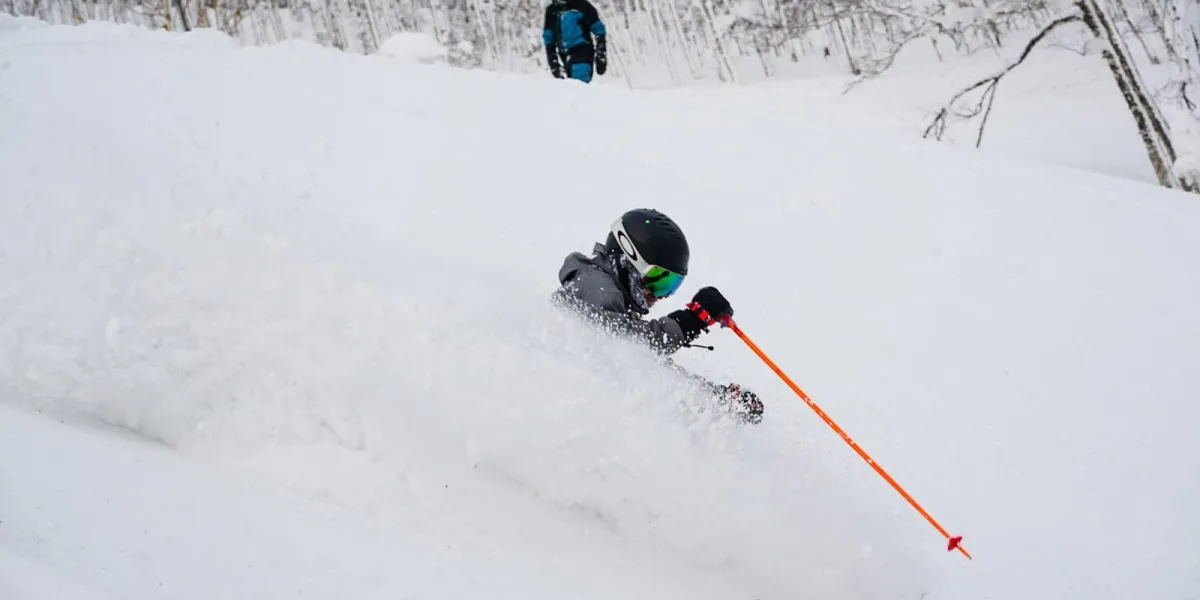
Every winter at Rusutsu and Niseko, we meet strong intermediate and advanced skiers who can carve confidently down any groomed black run in Europe, Australia, or North America—yet find their legs burning after three runs in knee-deep Hokkaido snow.
The reason is simple: skiing inside three-dimensional snow uses a completely different movement pattern than pushing against a hard, two-dimensional groomed surface. Once you make a few small adjustments to your equipment, stance, and rhythm, deep powder stops feeling like hard work and starts feeling weightless. Here is what our instructors teach on your first morning off-piste.
Start with the Right Ski Underfoot (105mm–118mm)
Before changing anything about your technique, set yourself up for success at the rental counter. A narrow 78mm–88mm frontside carving ski is built to slice into hardpack; in 40 centimeters of fresh Hokkaido snow, it will dive like a submarine and force you into defensive habits.
For typical mid-winter conditions in Hokkaido, rent or pack a dedicated freeride or powder ski measuring 105mm to 118mm underfoot with generous tip and tail rocker. Modern rockered tips rise naturally to the surface as soon as the ski moves forward, allowing you to stand centered over your bindings without fighting to keep your tips up. (Also make sure your ski poles have wide powder baskets so they don’t punch straight through to the bottom of the snowpack when you plant a pole.)
Break the “Lean Back” Myth: Stay Centered Over Both Feet
The single most common mistake first-time powder skiers make is leaning back to keep their ski tips from diving. While sitting in the backseat might keep the tips visible for a moment, it locks the tails of your skis into the snow like a rudder, makes steering nearly impossible, and exhausts your quadriceps by 11:00 AM.
Instead, focus on three core stance adjustments:
- Keep Your Shins Lightly Against Your Boot Tongues: Let the wide shovel and rocker of a modern powder ski create the float. Keep your hips over your bindings and your weight centered through the middle of your foot.
- Weight Both Skis Equally (50/50 Pressure): On a groomed run, you balance primarily on your outside downhill ski. If you put 90% of your weight on one ski in deep snow, that weighted ski will sink while your light inside ski floats upward—causing your legs to split apart. Bring your feet slightly closer together into a consistent, hip-width platform and distribute your weight evenly across both skis.
- Think Up-and-Down, Not Side-to-Side: Rather than jamming your edges sideways to brake, use a smooth, rhythmic flexing and extending motion (like bouncing gently on a trampoline). When you press both skis down into the soft snow, the snow compresses and rebounds—popping your skis effortlessly toward the surface so you can pivot into the next turn while they feel weightless.
Let Speed Create Float on Low-Angle Terrain
Just like waterskiing, powder skis need a baseline amount of forward momentum to plane toward the surface. If you make abrupt, Z-shaped braking turns across the slope, you kill your speed, sink deeper into the snowpack, and work twice as hard to start the next turn.
Point your skis slightly closer to the fall line and make longer, rounder S-turns. Because fresh Hokkaido snow provides natural, cushioned resistance, you can ski a steeper line than you normally would on hardpack without accelerating out of control. That natural snow resistance acts as a gentle brake while keeping your skis floating smoothly near the top of the snow.
How to Ski Storm Days and Flat Light in the Birch Trees
If you wait for a sunny, cloudless sky to ski powder in Hokkaido, you will miss the best days of your trip. In January and early February, Siberian storm systems roll across the Sea of Japan almost daily, bringing constant snowfall and overcast “flat light” on open alpine bowls.
When visibility drops on the upper open runs, head straight into the Erman’s birch glades (such as Bambi and East Vivaldi for intermediates, or Heavenly Canyon and Steamboat on Mt. Isola at Rusutsu):
- Trees Provide Instant Depth Perception: Dark tree trunks and branches cast natural contrast against the snow, allowing your eyes to read every roller, wind-lip, and pitch change even during a heavy snowfall.
- Look at the Spaces, Not the Trunks: Your skis always follow your eyes. Keep your gaze three turns ahead, looking through the wide corridors of white snow between the trees rather than staring at the tree trunks themselves.
- Wear a High-Contrast Storm Goggle Lens: Leave dark black or silver mirror lenses in your hotel room on storm mornings. A rose, yellow, or clear/amber low-light lens makes snow contours pop in overcast conditions.
The “X-Poles” Trick: How to Stand Up After a Fall in Deep Snow
Everyone tumbles in deep powder eventually—and because the snow in Hokkaido is so soft, falling rarely hurts. The real challenge is trying to push yourself back up when your hand sinks straight down to your shoulder every time you press on the snow.
Instead of fighting the snow with your bare hands, use the X-Poles technique:
- Position both skis parallel to each other across the slope below your hips (perpendicular to the fall line so they won’t slide away).
- Lay one ski pole flat on the snow, and cross your second pole over it in an “X” shape.
- Grip the center intersection of the “X” with your uphill hand and push down on the crossed poles. The two poles distribute your weight across the surface like a snowshoe, giving you a solid platform to stand right back up without burning your energy.
Frequently Asked Questions
What waist width ski should I rent for Hokkaido powder?
For an all-around Hokkaido trip where you ski both groomed runs and off-piste powder, a ski between 102mm and 110mm underfoot is ideal. On deep storm mornings (25cm+ overnight), stepping up to a dedicated 112mm–120mm powder ski with tip and tail rocker makes floating in deep snow effortless.
Do I need to move my bindings back for powder skiing?
No. If you are skiing modern freeride or powder skis built within the last five years, the manufacturer’s recommended mount point is already engineered to work with the ski’s rocker profile. Mounting or sliding bindings far back is a relic of older, straight-cambered skis and actually makes modern skis harder to steer in trees.
How can a private lesson help if I already ski black runs on groomed snow?
Even a single half-day or full-day private session on your first morning in Hokkaido saves days of trial and error. An instructor will dial in your two-footed stance, teach you how to control speed in spaced birch trees without skidding, and take you directly to gentle, confidence-building powder pitches before moving to steeper terrain.